Artificial intelligence is no longer a future concept. It’s already transforming healthcare, manufacturing, education, public safety, and countless aspects of our daily lives. Behind that technology are data centers requiring significant infrastructure, energy, and, in many cases, substantial water resources.
That brings us to an important conversation taking place in our region with the proposed AI data center development in Grayslake.
Like many significant development decisions, this is not a simple question with a simple answer.
Supporters point to substantial private investment, infrastructure improvements, an expanded tax base, and long-term economic opportunities. Others raise important questions about energy demand, water usage, environmental impacts, traffic, noise, and the long-term effects on surrounding communities.
Both perspectives deserve to be heard, and both raise valid questions that should be addressed through facts, transparency, and responsible planning.
One common misconception is that decisions like these rest solely with a village board or city council. They do not.
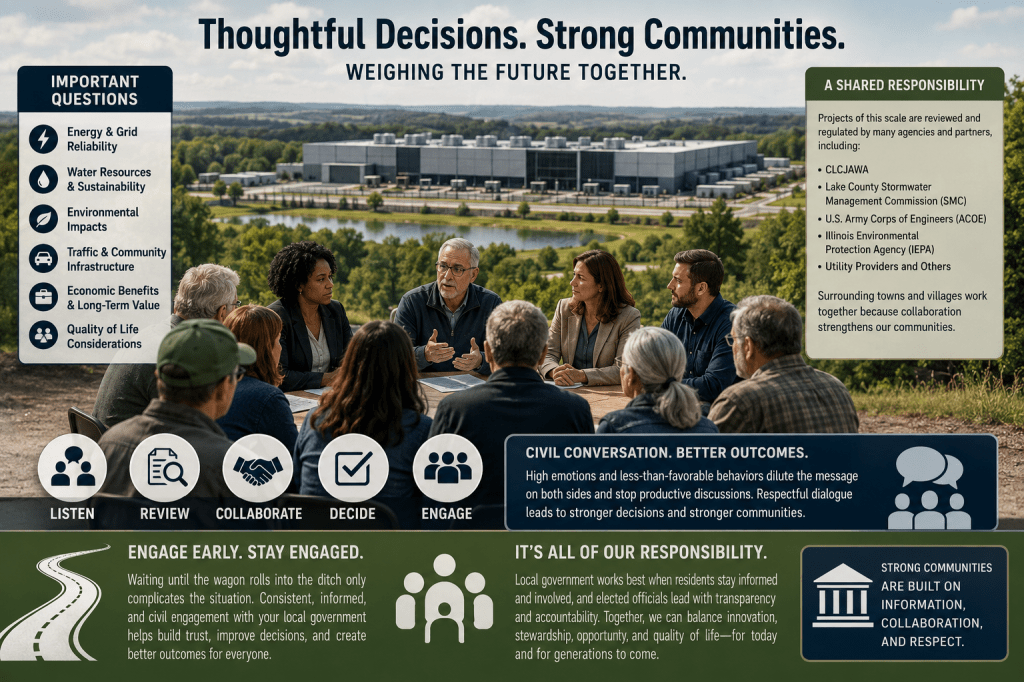
Projects of this scale undergo extensive engineering reviews and are subject to oversight by numerous local, regional, state, and federal agencies. Organizations such as CLCJAWA, the Lake County Stormwater Management Commission, the U.S. Army Corps of Engineers, the Illinois Environmental Protection Agency, utility providers, and other regulatory bodies all play important roles in reviewing and evaluating different aspects of these developments.
It’s also important to recognize that municipalities do not operate in isolation. Throughout our region, neighboring towns and villages have built strong working relationships founded on communication, cooperation, and mutual respect. Local leaders understand that collaboration is almost always more productive than working independently, particularly when infrastructure, utilities, transportation, water resources, and economic development extend beyond a single municipal boundary.
That doesn’t eliminate the need for public input or difficult conversations. It does, however, underscore that these decisions involve far more than a single vote by a village board or city council. They are informed by technical expertise, regulatory oversight, intergovernmental cooperation, and a shared responsibility to consider both local interests and regional impacts.
Residents should absolutely ask questions. They should expect transparency, accountability, and honest answers from both developers and their elected officials. Public participation is an essential part of good government and leads to better decision-making.
Unfortunately, conversations surrounding projects of this magnitude can become highly emotional. Passion is understandable and often reflects how deeply people care about their community and their future.
The challenge comes when productive dialogue gives way to personal attacks, assumptions about motives, or rhetoric that overshadows legitimate concerns and thoughtful discussion. The loudest voices can begin to drown out the most constructive ones, making it harder for residents and elected officials to engage in meaningful conversations based on facts rather than emotion.
This is also another reminder of something much broader than a single project. Strong communities are built through consistent and constructive civic engagement, not just participation during moments of controversy.
Too often, people become engaged only after they feel the wagon has already rolled into the ditch. By that point, positions have hardened, emotions are elevated, and finding common ground becomes far more difficult. Early involvement, regular communication, and respectful dialogue create better outcomes for everyone.
Local government works best when residents stay informed, attend meetings, ask questions, participate in planning processes, and build relationships with their elected officials long before difficult decisions arise. Likewise, elected officials have a responsibility to be accessible, transparent, and willing to listen.
Civic engagement is not just the responsibility of those elected to serve. It belongs to all of us. An informed and engaged community creates stronger local government, better public policy, and greater trust between residents and the people who represent them.
Communities are strongest when people can disagree respectfully, ask difficult questions, and remain willing to listen to one another. Residents deserve transparency. Developers should expect scrutiny. Elected officials have a responsibility to carefully evaluate the information before them and make decisions they believe are in the community’s best long-term interest.
Reasonable people can reach different conclusions on projects like these.
The objective should not be to win an argument or dismiss opposing viewpoints. It should be to foster informed, respectful dialogue, rely on sound facts and expert analysis, and recognize that the best outcomes are often achieved through collaboration among residents, neighboring communities, regulatory agencies, developers, and elected officials.
As AI continues to reshape our world, communities across Illinois and the nation will continue to face these conversations. While opinions on individual projects may differ, one principle should remain constant: decisions are best made through transparency, collaboration, mutual respect, and a commitment to balancing innovation, environmental stewardship, economic opportunity, and the long-term interests of the communities we call home.
Perhaps the greatest lesson from discussions like these has little to do with AI or data centers at all. It is a reminder that democracy works best when participation is ongoing, not occasional. If we want thoughtful decisions, we must also be willing to invest our own time in thoughtful engagement. That responsibility belongs to every resident, every elected official, and every stakeholder who has a role in shaping the future of our communities.

